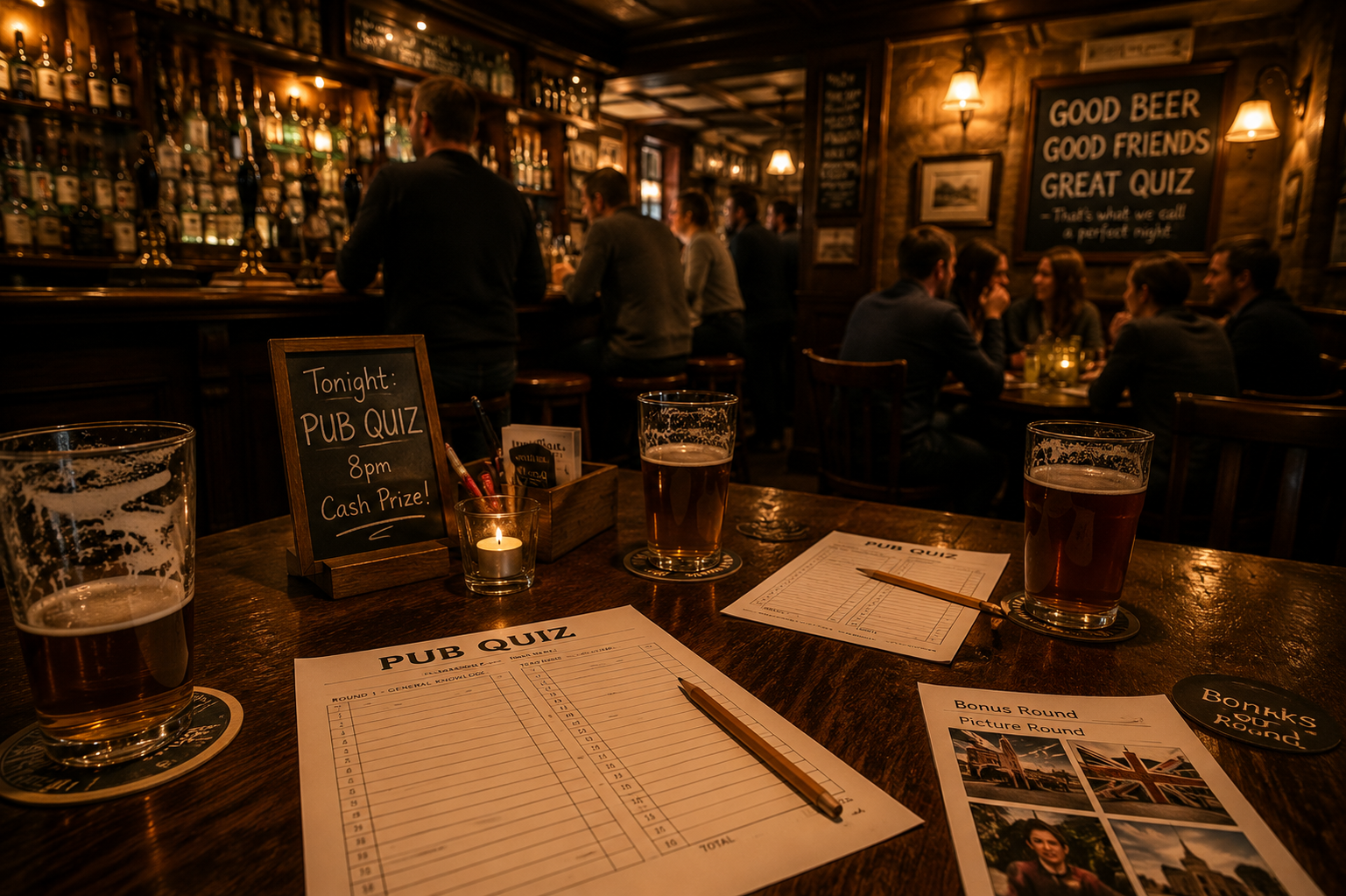
There's a particular atmosphere in a British pub on quiz night that you won't find anywhere else. The hush that falls when a question is read out. The furious whispered debates at each table. The team in the corner who take it far too seriously, and the team by the bar who are mainly here for the beer but somehow keep winning. The pub quiz is one of Britain's great democratic institutions, and like many great institutions, it's under pressure.
How It Started
The modern pub quiz emerged in the 1970s, though its roots go deeper — into the British tradition of parlour games, penny quizzes, and the national habit of showing off knowledge while pretending not to. A Liverpool entrepreneur named Burns and Porter is often credited with formalising the format, but in truth it evolved organically, spreading from pub to pub through imitation rather than franchise.
By the 1990s, the pub quiz was ubiquitous. Every neighbourhood local seemed to have one. Tuesday night at the Red Lion, Thursday at the Crown. Teams had names, rivalries, and legends — the question that decided the championship in 1997, the time someone genuinely knew the capital of Burkina Faso without cheating.
The Smartphone Problem
The rise of the smartphone should have killed the pub quiz. When every answer is a three-second Google search away, the entire premise — that knowledge is something you carry in your head — feels anachronistic. And yet the quiz persists, partly through honour systems and partly through the social understanding that Googling the answer is cheating in the same category as match-fixing or queue-jumping: technically possible but morally unforgivable.
The better quiz hosts have adapted. Picture rounds, audio rounds, questions that require lateral thinking rather than recall — these are harder to Google and more entertaining to argue about. The format has evolved, even if the essential ritual remains the same.
More Than Trivia
What makes the pub quiz matter isn't the questions. It's the fact that it gets people into the same room, talking to each other, sharing something that isn't work or family obligation. In an age of social fragmentation, the pub quiz remains one of the few regular occasions when strangers interact face-to-face in a structured but relaxed setting.
There's also the egalitarian aspect. A pub quiz doesn't care about your job title or your postcode. The retired postman who knows everything about geography sits alongside the university professor who can't name a single footballer. Knowledge, in the quiz, is beautifully non-hierarchical. Everyone knows something. Nobody knows everything.
A Quiet Survival
Reports of the pub quiz's death are premature. It's true that fewer pubs exist than twenty years ago, and that some of the ones that remain have replaced the quiz with karaoke or live sport. But in the pubs that still run a proper quiz — with a decent host, fair questions, and a jackpot that's worth arguing about — the tables fill up every week. The format is older than the internet, and it may well outlast it. Some things are too perfectly British to disappear entirely.